What is Copyright?
As referenced in the illustrious Oxford Dictionary.[1]Copyright is the exclusive legal right, provided to the originator of a piece of work for a set number of years, to; print, publish, perform, film or record literary, artistic, or musical material.
Introduction
Copyright is covered under civil law, and is a form of intellectual property. It has majorly ingrained itself in to the online environment in the internet age, with several high profile cases being taken to court as a result of alleged copyright infringement’s occurring online. This has thrust copyright into being one of the most hotly discussed and dealt with legal issues relating to cyber law.
Historical Development
In regards of the law on copyright in the online environment, it has had a very intriguing past particularly related to case law surrounding the issue.
Firstly, to fully develop an understanding of how copyright has developed and transformed into what it is today in an online sense. Copyright law predating the modern internet age, must first be delved in to.
https://youtu.be/H_aOHpn_vqQ
This YouTube clip created by ‘Copy-Me’[2] titled ‘Early Copyright History’- provides a good basis of how copyright developed hundreds of years preceding the internet age. The most important and relevant section discussed is the video is the Statute of Anne 1709 (Copyright Act 1709)[3], this was a parliament statute emanating from the UK and is regarded as a revolutionary peace in relation to copyright. This is for it transformed a previously prehistoric look on copyright law and, made it fairer and more transparent to everyone rather than selected few in a censorship state type manor. The Statute of Anne allowed the creators to own their own work, as opposed to a monopoly with government chosen publishers being able to choose what work should be published or not.
The further evolution of copyright law in the UK was slow, with the next prominent piece of legislation being hundreds of years later. This came in the form of the Copyright Act 1911[4], this act attempted to unify all previous legislation into one act which would govern all of copyright infringements, in turn this took away the common law of copyright.
This was further engrossed and amended within The Copyright Act 1956[5]. This act was brought in to deal with the advances in technology since the previous legislation, with a substantial technological advance where copyright was involved in. A key case that involves the act Is the case of- Independent Television Publications Limited V Time Out Limited (1984) FSR 64[6]
In this case, the plaintiff claimed a literary copyright against the defendant’s daily program through the 1956 Act which they claimed had been breached. The defendant used the defence of Fair dealing under Section 6 of the act, claiming they did not use a substantial section of the pursuers work.
It was Held that; there was a great deal of skill involved in preparing the daily show, and the defendant was using a great deal of this work. Furthermore, the defence of fair dealing under section 6 was for examples that used small parts of a persons work to review it. Thus, the defence of Fair dealing would not be sufficient here and the pursuer won the claim.
This case is a good example of how the 1956 act properly governed over copyright, having a strict but fair overview of what should be deemed as enough to constitute an offence. However, the issue with this act is although in some cases it would be sufficient to cover technological advances, the act was truly made long before the internet age and a new updated law would be required to keep copyright law up to date. This was brought in through the amendment from the UK copyright (Computer Software) Amendment Act 1985[7]. Although the amendment only lasted a few years before being overtaken by the most recent in copyright legislation.
Review of current law
Which came into place with, The Copyright, Designs and Patents Act 1988[8]. This act is the most recent and relevant legislation in relation to Copyright law, with several amendments made to it since its inception. It allows for protection to[9]‘Literary work’. Meaning work other than; musical work, which is written, spoken or sung and in addition includes a computer program. Thus, fully integrating software into the general principle for what is afforded copyright protection under legislation. In order for software to be provided with protection however, it must fulfil the criteria of; being original, been recorded and that it qualifies for protection within the UK.
The Originality criteria was set with a low threshold in the case of-
University of London Press ltd V University Tutorial Press Ltd[10]. The case was regarding exam papers written by academics for the University of London. Posing the question of do exams constitute copyright for being original work. Which it was held in this case to be a sufficient means of constituting a copyright and thus protection was granted for originality.
This case was the precedent set for the threshold in the UK for originality, which only requires that the author has not plagiarized the work. Thus, under the current legislation it is relatively easy for software to gain copyright protection as long as it is not copied from another source. This is certainly a positive aspect of the law as it allows good protection for ideas that are applying good skill and labour, which the UK legal system strongly considers when applying copyright to pieces of work.
However, where many argue the law is not sufficient is in the context or ‘piracy’. This is when people illegally download products such as; films, TV shows and Music. The act allows those guilty of piracy to be taken to court on such matters. However, the issue with piracy is how widespread it is and hard to contain. As shown from Variety.com[11], which stated how worldwide in 2017 ‘300 billion’ visits were made to illegal pirating sites, this was up ‘1.6%’ from 2016. This highlights just how many cases of illegal downloading occurs, this makes it extremely tough for law to cover and many argue the law regarding piracy is currently not fit for purpose and, must be cracked down upon as the vast majority have no consequences for piracy.
Lessig’s Modalities of regulation
Lessig’s modalities of regulation are the 4 methods of regulating cyber space set out by Lawrence Lessig. These are; Law, Market, Architecture and Norms.
Lessig himself explains all four in this clip from YouTube[12]
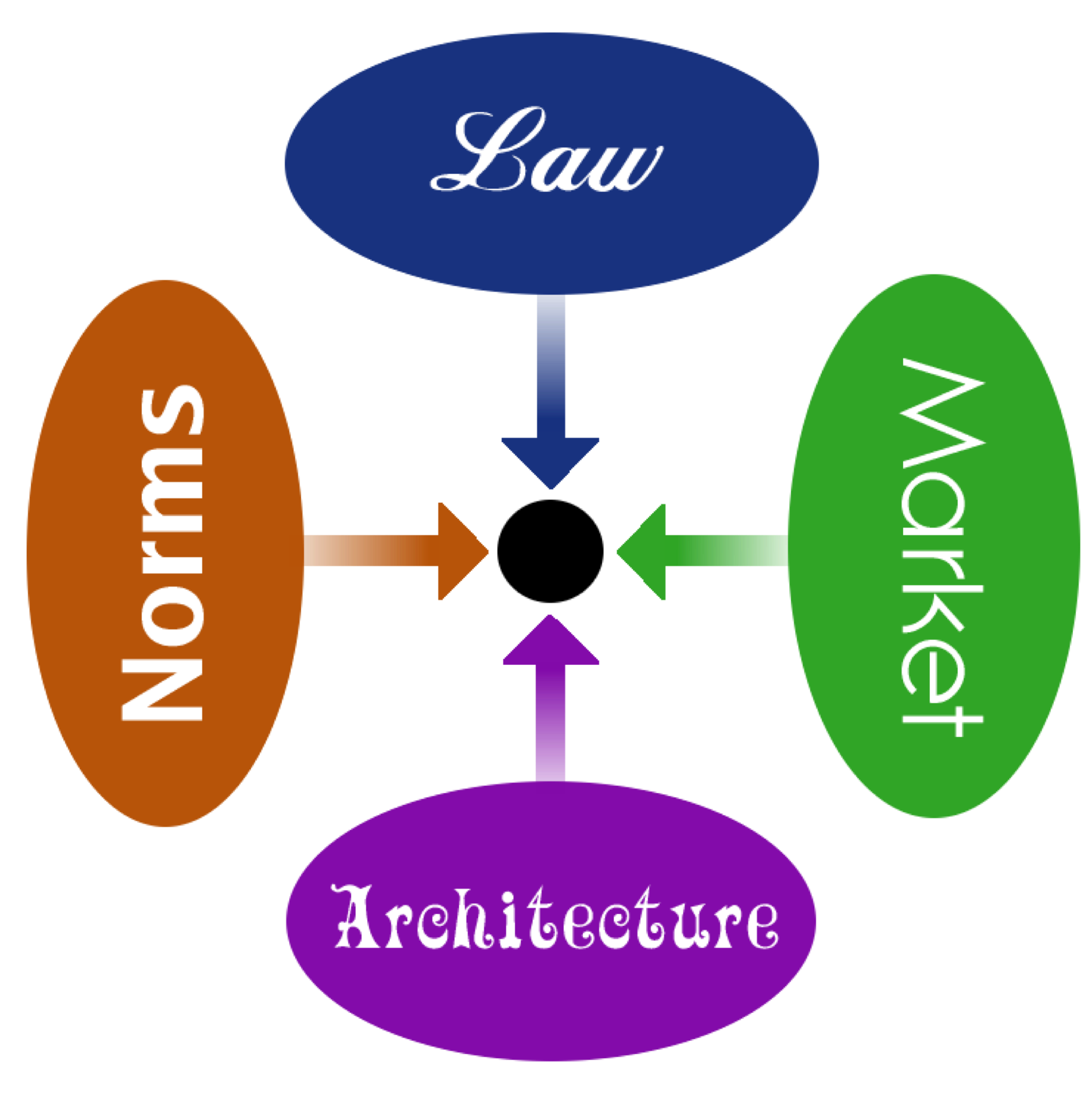

To summarise; Law in his context is mandates which can be used by government to enforce law online, this links to copyright through the legislations such as, the previously discussed and most current legislation of The Copyright Designs and Patents Act 1988.
Market is the economic forces which can regulate through, prices and price related signals which puts constrains upon people
Norms refer to social convictions that a person feels a need to follow and abide by such as, criticism if the person does something socially unacceptable.
Architecture is arguably the most important in relation to cyber law and refers to physical or technical constraints put on people, in a cyber context this can come in the form of firewalls or screens that pop up stating if they continue on to this page it is illegal and they may be prosecuted. This is a very good way of controlling cyber law and should arguably be used far more in copyright situations. Furthermore, it may be the way forward in terms of regulating piracy, this is for the current legal methods are very unlikely to prevent piracy, this is due to the sheer number of people participating in piracy. Which makes it in current form impossible to take legal action against all participants, architecture may have the solution to this by showing participants that if they continue on to download from this cite they shall be registered and can be prosecuted, this shall in theory prevent many from using the illegal means thus reducing piracy.
Conclusion
To conclude, it is clear from the extensive detail the blog enters into in terms of the history and evolution of copyright law in the UK. That major strides have been taken in the right direction, thus many shall be covered by copyright and can legally deal with any infringements put upon them. However, law has lead a gap in relation to piracy of copyrighted products for free, this is where Lessig’s modalities can provide a solution. In particular architecture in correlation with law. Which as suggested could help turn millions of people from piracy and towards paying the going rate for the copyrighted products. Although, it is not a perfect solution and wont end piracy it is very likely to reduce it majorly due to a more real sense of fear of prosecution for breaching copyright in this sense.
References- Primary + Secondary
- The Oxford Dictionary<>Copyright Definition<
- YouTube> Published by ‘Copy-Me’ October 13th2014<> ‘Early Copyright History<>https://youtu.be/H_aOHpn_vqQ<>Last Accessed 7thof April 2019<
- The Guardian ‘The Statute of Anne’><August 6th2007<>’The Guardian’<
- Legislation.gov.uk>http://www.legislation.gov.uk/ukpga/Geo5/1-2/46/contents/enacted<>Copyright Act 1911 c.46<>Last Accessed 7thApril 2019<
- The Copyright Act 1956c.74
- Westlaw.co.uk><Ihttps://login.westlaw.co.uk/maf/wluk/app/document?docguid=IC64D40A0E42711DA8FC2A0F0355337E9&context=5&crumb-action=append<Independent Television Publications Limited V Time Out Limited (1984) FSR 64> Last Accessed 8thApril 2019<
- The UK copyright (Computer Software) Amendment Act 1985
- the Copyright, Designs and Patents Act 1988 (CDPA)
- Information Technology Law 3rdEdition by Andrew Murray y> Oxford Press 2016<> Chapter 10.2<
- University of London Press Ltd V University Tutorial Press Ltd> Information Technology Law 3rdEdition by Andrew Murray y> Oxford Press 2016<> Chapter 10.2.1<
- Variety.com>Global Piracy in 2017>‘TV and Music Illegal activity rose, while film declined’<>By Todd Spangler March 21st2018<>Last Accessed 8thApril<
- Youtube><>https://youtu.be/EXOv1doHp88< By The Berkman Klien Centre for Internet & Society<> Published August 5th2011<>Last Accessed 8thApril 2019<
Footnotes Part A
[1]The Oxford Dictionary- Copyright Definition
[2]Youtube- ‘Copy-Me’- Early Copyright History
[3]Statute of Anne 1710
[4]Copyright Act 1911 c. 46
[5]The Copyright Act 1956
[6]Independent Television Publications Limited V Time Out Limited (1984)
[7]The UK copyright (Computer Software) Amendment Act 1985
[8]The Copyright, Designs and Patents Act 1988[8]
[9]Information Technology Law 3rdEdition by Andrew Murray
[10]University of London Press ltd V University Tutorial Press Ltd
[11]Variety.com, By Todd Spangler, March 21st2018
[12]Lawrence Lessig Four types of regulation- YouTube

 Cyber Law Blog